

Tandem skydiving – FAQ and knowledge base
We have prepared a comprehensive FAQ and knowledge base about tandem skydiving so you can have clear, accurate, and verified information before your jump. Here you will learn what a tandem skydive looks like, how long freefall lasts, from what altitude you jump, how safe tandem skydiving is, how to prepare, and what to expect before, during, and after the jump.
For some, skydiving is an unforgettable recreational experience and a way to step outside their comfort zone. For others, it is a professional sport and a lifelong passion. Through tandem skydiving, we make a safe and controlled first experience accessible to everyone.
What is a tandem skydive?
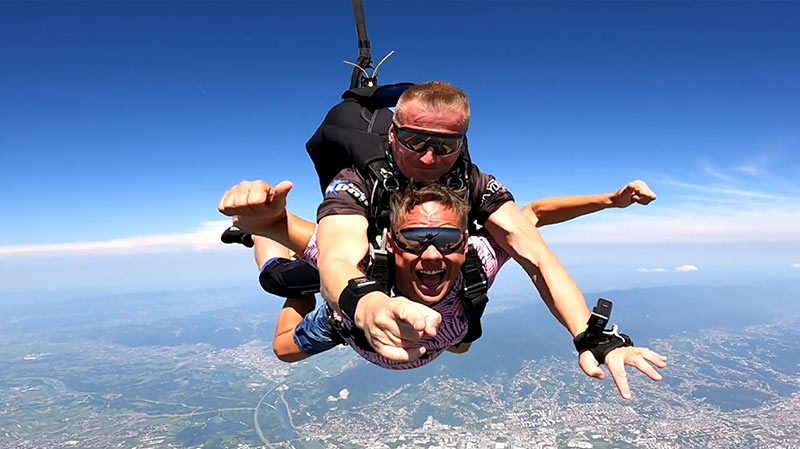
A tandem skydive is one of the safest and most popular ways to experience skydiving for the first time. The passenger jumps together with an experienced tandem instructor who is responsible for all critical actions during the jump – from aircraft exit and freefall to parachute deployment and safe landing.
Tandem skydiving also allows for a very short preparation time, meaning you can go from arrival at the airfield to jumping without any previous skydiving experience.
What is the difference between a tandem jump and a solo jump?
The main difference is responsibility. In a solo skydive, you are responsible for all procedures yourself. In a tandem skydive, all key actions – exit, stability, parachute deployment, canopy flight, and landing – are handled by the tandem instructor, allowing you to fully focus on the experience.
Is training required before a tandem skydive?
Yes. Before every tandem skydive, you will receive a short pre-jump briefing lasting approximately 10–15 minutes. During the briefing, the instructor explains aircraft procedures, exit position, body position during freefall, parachute flight, and landing techniques. The briefing is simple and designed for people with no prior experience.
From what altitude do tandem jumps take place?
Tandem skydives are typically performed from altitudes between 3,000 and 4,000 meters. The exact altitude depends on the airport and aircraft. Whenever possible, we prioritize locations that allow the highest jump altitude for the best overall experience.
How long does a standard tandem skydive last?
The aircraft climb usually takes between 10 and 25 minutes and includes a scenic flight. Freefall duration depends on exit altitude and body weight: approximately 40 seconds from 3,000 meters and up to 60 seconds from 4,000 meters. After that, canopy flight lasts about 5–10 minutes, during which the instructor may allow you to briefly steer the parachute.
What aircraft are used for skydiving?
Aircraft depend on the drop zone. Jumps may be conducted from smaller single-engine aircraft such as the Cessna 182 or Cessna 206 (up to 5 skydivers), larger multi-engine aircraft like the Turbolet L-410 (over 20 skydivers), and helicopters, including larger models such as the MI-8 (around 20 skydivers).
How fast is freefall and what does it feel like?
After exit, you accelerate for the first 10 seconds until reaching terminal velocity. Depending on body weight, this is approximately 200–250 km/h. Most people describe the sensation not as “falling,” but as “lying on air.”
Can I breathe during freefall?
Yes. You can breathe normally during freefall. In rare cases, breathing discomfort is caused by nervousness. The key is simple: breathe normally in the aircraft and continue doing so throughout the jump. Your instructor will remind you.
Will my eyes water during freefall?
They can if the goggles are not properly adjusted. If you feel air leaking, inform your instructor and they will tighten them before exit.
At what altitude is the parachute deployed?
The minimum parachute deployment altitude for tandem jumps is 1,500 meters above ground level.
Is there a strong opening shock?
No. Tandem parachutes are packed to ensure a gradual opening. The sensation is usually compared to firm braking in a car rather than a sudden jerk.
How long does canopy flight last?
Canopy flight typically lasts 5–10 minutes. Dynamic maneuvering shortens the descent, while relaxed flight extends it.
What is landing like?
Landing is often compared to an aircraft landing. Tandem parachutes are designed like wings and can generate lift for a very soft touchdown. You will receive clear landing instructions during the briefing.
What if I am afraid of heights?
Most people do not fear height itself, but fear falling. In freefall, there is usually no sensation of falling, only floating. As a result, fear is often replaced by excitement.
Can I pass out during the jump?
The likelihood is extremely low. Increased adrenaline and heart rate make loss of consciousness very unlikely. We recommend a light meal and proper hydration before the jump.
Can I cancel the jump after takeoff?
You can choose not to jump at any time. However, in such cases, the jump is non-refundable.
What is the maximum allowed weight?
The maximum passenger weight is generally 110 kg for men and 100 kg for women. Passengers above 100 kg must consult with us in advance, as physical condition also plays a role.
What are the age limits?
The minimum legal age is 14 years, with written parental consent. There is no maximum age limit as long as the person is physically capable.
Where do you perform tandem skydives?
We operate throughout Croatia and neighboring countries. Regular locations include Zagreb, Varaždin, and Čakovec, as well as Slovenia (Šentvid pri Stični, Metlika, Ptuj, Maribor). Location affects maximum jump altitude depending on the aircraft.
Are tandem instructors licensed?
Yes. All our tandem instructors hold valid tandem ratings and licenses, including CCAA and USPA certifications, as well as manufacturer authorizations (UPT, Strong Enterprises, ParaAvis). Many are current or former members of the Croatian national skydiving team.